Creating After the Machine Stops Being the Measure
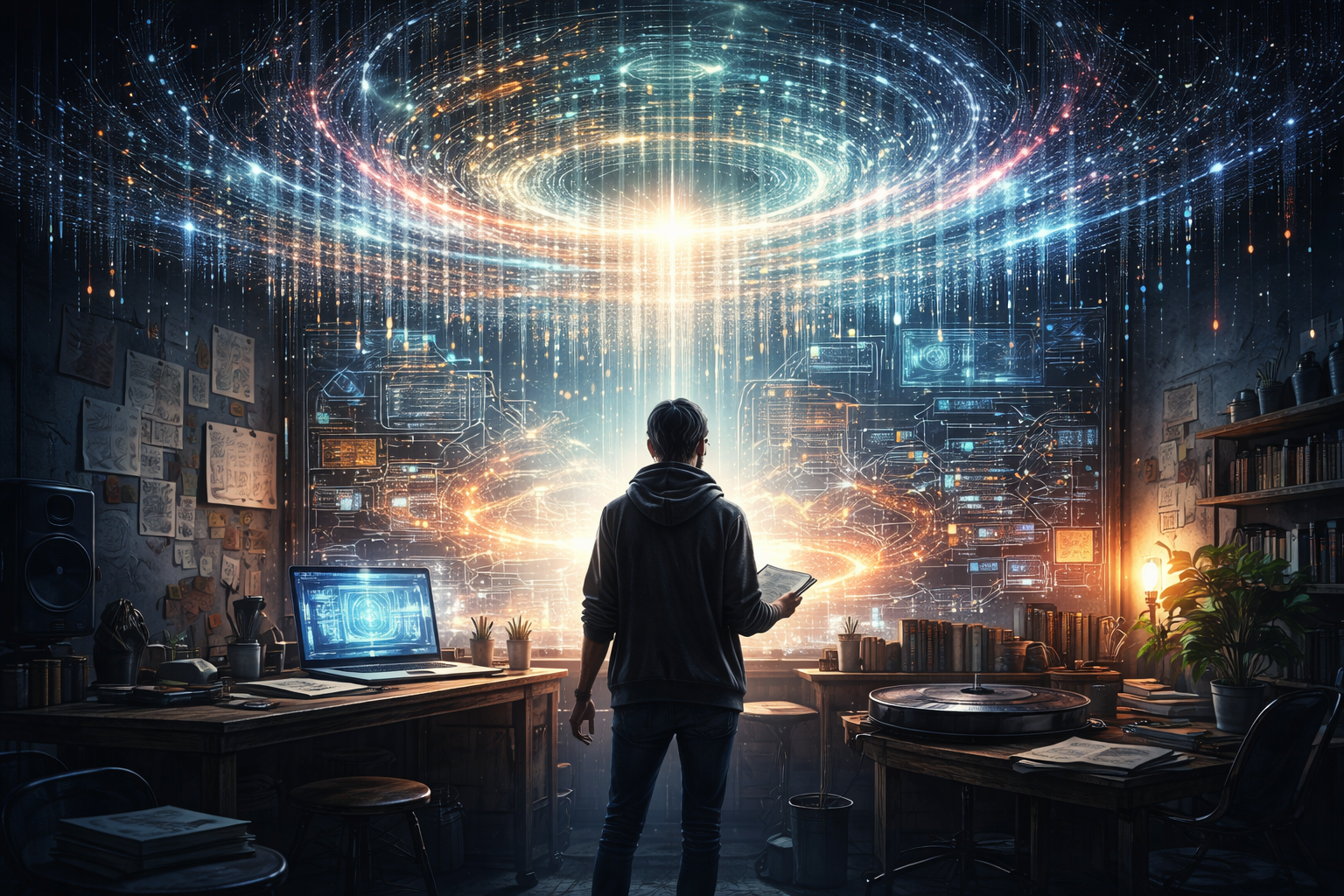
There is a moment many artists reach quietly, without ceremony, when the algorithm stops feeling like a tool and starts feeling like a pressure field.
Not because they failed to “figure it out.”
But because they did.
They learned how to post.
They learned what performs.
They learned how to compress their voice into something that moves quickly, provokes reaction, and disappears just as fast.
And somewhere along the way, the work began to feel thinner.
Not worse.
Thinner.
This is the moment post-algorithmic creativity begins.
What “Post-Algorithmic” Actually Means
Post-algorithmic creativity does not mean rejecting platforms, visibility, or technology. It does not mean going offline, refusing AI, or romanticizing obscurity.
It means this:
The algorithm is no longer allowed to be the primary feedback system for what you make.
Post-algorithmic creators still publish.
They still share.
They still allow their work to circulate.
But they stop letting optimization decide:
• What gets made
• How it sounds
• How fast it must land
• What parts of themselves are acceptable
The work stops asking, “Will this perform?”
And starts asking, “Is this coherent?”
The Algorithm’s Hidden Cost
The algorithm doesn’t care about meaning.
It cares about reaction velocity.
It rewards:
• Immediacy over depth
• Familiarity over originality
• Emotional spike over emotional truth
• Repetition over evolution
Over time, this trains creators to:
• Explain too much
• Simplify too early
• Perform urgency
• Eliminate silence
• Fear latency
Eventually, the work stops surprising even the person who made it.
That’s not because the creator ran out of ideas.
It’s because the system punished anything that didn’t translate instantly.
Post-algorithmic creativity is the decision to stop flattening dimensional work for a one-dimensional metric.
Coherence as the New Measure
In a post-algorithmic framework, success is no longer measured by reach alone.
It’s measured by coherence.
Coherence means:
• The work sounds like it could only come from you
• The form matches the content
• The pace matches the intention
• The process feels sustainable
• The work still makes sense months or years later
Coherence is invisible to algorithms — but unmistakable to humans.
People may arrive slower.
But they arrive more prepared.
And they stay longer.
Depth Is Not a Flaw
One of the algorithm’s most corrosive effects is convincing artists that depth is a liability.
That nuance loses attention.
That silence kills momentum.
That complexity should be hidden or apologized for.
Post-algorithmic creativity rejects this.
It understands that:
• Confusion can be a doorway
• Mystery can be generative
• Not everything is meant to resolve immediately
Some work is not designed to be consumed at the speed it’s distributed.
Some work needs time to find the right nervous system.
AI in a Post-Algorithmic World
Post-algorithmic creativity is not anti-AI.
It is anti-using AI as a shortcut to compliance.
Instead of asking AI to:
• Generate volume
• Mimic trends
• Optimize hooks
• Replace authorship
Post-algorithmic creators use AI as:
• A thinking partner
• A mirror
• A way to extend cognition without replacing intuition
• A tool for dialogue, not delegation
AI becomes part of the process — not the decider of what matters.
The goal is not efficiency.
The goal is expanded perception.
Time as an Ally
The algorithm treats time as an enemy.
If something doesn’t land immediately, it’s considered dead.
Post-algorithmic creativity treats time as an ally.
It accepts that:
• Some work matures after release
• Some audiences arrive late
• Some things only make sense in retrospect
It allows pieces to:
• Breathe
• Age
• Accumulate meaning
Not everything needs to peak.
Some things are meant to settle.
Silence Is Not Failure
In algorithmic culture, silence is framed as absence — something to fix.
In post-algorithmic practice, silence becomes part of the signal.
Silence can mean:
• Integration
• Discernment
• Rest
• Refusal
• Respect for the work
Naming pauses without apology restores agency to the creator and recalibrates expectations for the audience.
Silence filters impatience.
Patience filters seriousness.
What Post-Algorithmic Creativity Is Not
It is not:
• Anti-visibility
• Anti-growth
• Anti-success
• Anti-distribution
It is anti-distortion.
Post-algorithmic creators still want their work to be seen —
they just refuse to deform it to get there.
They are more interested in:
• Who stays than who clicks
• What lasts than what spikes
• What they can stand behind years later
The Quiet Power Shift
The deepest shift in post-algorithmic creativity is internal.
The creator stops asking:
“How do I make this land?”
And starts asking:
“What is true enough to wait for?”
That question changes:
• How often you post
• What you’re willing to release
• What you’re willing to leave unfinished
• What you’re willing to protect
It replaces anxiety with position.
Why This Matters Now
More people than ever are burning out not because they lack talent —
but because they are trapped in systems that reward speed over integrity.
Post-algorithmic creativity offers an exit that doesn’t require disappearing.
It offers a way to:
• Stay visible without selling your nervous system
• Use technology without being shaped by it
• Make work that still feels alive after the metrics fade
This is not a movement.
It’s not a brand.
It’s not a manifesto you have to defend.
It’s simply a decision about what you allow to shape your work.
A Closing Thought
If your work feels slower lately — that may be because it’s becoming truer.
If fewer people understand it immediately — that may be because it’s no longer optimized for the average response.
If you’re tired — not from creating, but from performing creation — you’re not behind.
You may already be working post-algorithmically.
And if so, you don’t need to announce it.
Just keep making work that doesn’t panic when it’s ignored —
and trusts that the right recognition doesn’t rush.